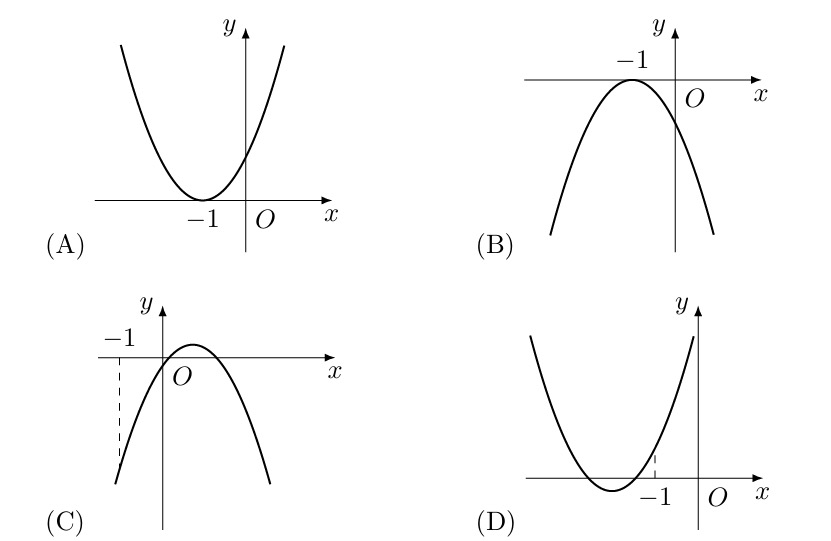
【2023新高考II卷11】(多选)若函数\(\displaystyle f(x)=a\ln x+\frac{b}{x}+\frac{c}{x^2}(a\neq 0)\)既有极大值也有极小值,则
\(\displaystyle bc>0\)
\(\displaystyle ab>0\)
\(\displaystyle b^2+8ac>0\)
\(\displaystyle ac<0\)
答案
BCD.
由\(\displaystyle f\left(x\right)=a\ln x+\frac{b}{x}+\frac{c}{x^2}\left(a\ne0\right)\),得\(\displaystyle f'\left(x\right)=\frac{a}{x}-\frac{b}{x^2}-\frac{2c}{x^3}=\frac{1}{x^3}\left(ax^2-bx-2c\right)\).
因为\(\displaystyle f\left(x\right)\)的定义域是\(\displaystyle \left(0,+\infty\right)\),要使\(\displaystyle f\left(x\right)\)既有极大值又有极小值,方程\(\displaystyle f'\left(x\right)=0\)有两个不同的正根,即方程\(\displaystyle ax^2-bx-2c=0\)有两个正根\(\displaystyle x_1\),\(\displaystyle x_2\).因此,\(\displaystyle \Delta=b^2+8ac>0\),\(\displaystyle x_1+x_2=\frac{b}{a}>0\),\(\displaystyle x_1x_2=-\frac{2c}{a}>0\).所以\(\displaystyle a,b\)同号;\(\displaystyle a,c\)异号;\(\displaystyle b,c\)异号.综上,A错误,B正确,C正确,D正确.
- 【2011湖南文7】
求曲线 \(\displaystyle y=\frac{\sin x}{\sin x+\cos x}-\frac{1}{2}\) 在点 \(\displaystyle M\left(\frac{\pi}{4},0\right)\) 处的切线的斜率.
答案
\(\displaystyle \frac{1}{2}\).
- 【2024 全国甲文7 理6】设函数\(\displaystyle f\left(x\right)=\frac{\mathrm{e}^x+2\sin x}{1+x^2}\),求曲线\(\displaystyle y=f\left(x\right)\)在点\(\displaystyle \left(0,-1\right)\)处的切线与两坐标轴所围成的三角形的面积。
答案
由\(\displaystyle f'\left(x\right)=\frac{\left(\mathrm{e}^x+2\cos x\right)\left(1+x^2\right)-2x\left(\mathrm{e}^x+2\sin x\right)}{\left(1+x^2\right)^2}\),得曲线\(\displaystyle y=f\left(x\right)\)在点\(\displaystyle \left(0,1\right)\)处的切线斜率为\(\displaystyle k=f'\left(0\right)=3\),从而得切线方程为\(\displaystyle y=3x+1\).该切线与两坐标轴的交点分别为\(\displaystyle \left(-\frac{1}{3},0\right)\)和\(\displaystyle \left(0,1\right)\),故切线与两坐标轴所围成的三角形的面积为\(\displaystyle \frac{1}{2}\times\frac{1}{3}\times1=\frac{1}{6}\).
- 【2020北京理19】已知函数 \(\displaystyle f(x) = 12 - x^2\).设曲线 \(\displaystyle y = f(x)\) 在点 \(\displaystyle (t, f(t))\) 处的切线与坐标轴围成的三角形的面积为 \(\displaystyle S(t)\),求 \(\displaystyle S(t)\) 的最小值.
答案
32.
- 【2009安徽9】已知函数 \(\displaystyle f(x)\) 在 \(\displaystyle \vv{R}\) 上满足 \(\displaystyle f(x)=2f(2-x)-x^2+8x-8\),求曲线 \(\displaystyle y=f(x)\) 在点 \(\displaystyle (1,f(1))\) 处的切线方程.
答案
\(\displaystyle y=2x-1\).
思路1:由$\displaystyle f\left(x\right)=2f\left(2-x\right)-x^2+8x-8$,解得$\displaystyle f\left(x\right)=x^2$,于是$\displaystyle f\left(1\right)=1$,$\displaystyle f'\left(1\right)=2$,故切线方程为$\displaystyle y=2x-1$.
思路2:令\(\displaystyle x=1\),则\(\displaystyle f\left(1\right)=2f\left(1\right)-1\),解得\(\displaystyle f\left(1\right)=1\).求导可得\(\displaystyle f'\left(x\right)=-2f'\left(2-x\right)-2x+8\),令\(\displaystyle x=1\)可得\(\displaystyle f'\left(1\right)=-2f'\left(1\right)+6\),解得\(\displaystyle f'\left(1\right)=2\).故在点\(\displaystyle \left(1,f\left(1\right)\right)\)处的切线方程是\(\displaystyle y=2x-1\).
- 【2025“fiddie”模拟考13】设函数 \(\displaystyle f(x) = a\sin x + \sin 2x + \sin 3x\).已知曲线 \(\displaystyle y = f(x)\) 在点 \(\displaystyle (x_0, f(x_0))\) 处的切线方程为 \(\displaystyle y = x + \pi\),求曲线 \(\displaystyle y = f(x)\) 在点 \(\displaystyle (2\pi - x_0, f(2\pi - x_0))\) 处的切线方程.
答案
\(\displaystyle y=x-3\pi\).
可知 \(\displaystyle f(2\pi-x)=-f(x)\),于是
\(\displaystyle f'(2\pi-x)=f'(x)\),故
\(\displaystyle f'(2\pi-x_0)=f'(x_0)=1,f(2\pi -x_0)=-f(x_0)=-x_0-\pi\)。
故所求切线为\(\displaystyle y=f'(2\pi-x_0)(x-(2\pi-x_0))+f(2\pi-x_0)=x-3\pi.\)
- 设\(\displaystyle \Delta ABC\)的三边长为\(\displaystyle a,b,c\),\(\displaystyle C\)为直角,判断\(\displaystyle f(x) = a\mathrm{e}^{ax} + b\mathrm{e}^{bx} - c\mathrm{e}^{cx}\)在\(\displaystyle (0,+\infty)\)上的单调性.
答案
因为 \(\displaystyle C\) 为直角,故 \(\displaystyle c^2=a^2+b^2\),且 \(\displaystyle c>a,b>0\)。对函数求导得
\(\displaystyle f'(x)=a^2\mathrm{e}^{ax}+b^2\mathrm{e}^{bx}-c^2\mathrm{e}^{cx}\)。
当 \(\displaystyle x>0\) 时,\(\displaystyle \mathrm{e}^{cx}>\mathrm{e}^{ax}\) 且 \(\displaystyle \mathrm{e}^{cx}>\mathrm{e}^{bx}\),从而
\(\displaystyle c^2\mathrm{e}^{cx}=a^2\mathrm{e}^{cx}+b^2\mathrm{e}^{cx}>a^2\mathrm{e}^{ax}+b^2\mathrm{e}^{bx}\)。
所以 \(\displaystyle f'(x)<0\) 在 \(\displaystyle \left(0,+\infty\right)\) 上恒成立,故 \(\displaystyle f(x)\) 在 \(\displaystyle \left(0,+\infty\right)\) 上严格单调递减。
- 【2021新高考I卷15】 求函数\(\displaystyle f\left(x\right) = |2x - 1| - 2\ln x\)的最小值。
答案
1.
- 已知\(\displaystyle x_1\),\(\displaystyle x_2\)是函数\(\displaystyle f(x) = a\ln x + \frac{2}{x} - \frac{1}{2x^2}\)在定义域上的两个极值点,若\(\displaystyle f(x_1) + f(x_2) = \frac{2}{\mathrm{e}} + 2\),求\(\displaystyle a\)的值.
答案
\(\displaystyle a=\frac{1}{\mathrm \mathrm{e}}\).
对 \(\displaystyle f(x)\) 求导,得
\(\displaystyle f'(x)=\frac{ax^2-2x+1}{x^3}\)。
题设有两个极值点,故方程 \(\displaystyle ax^2-2x+1=0\) 有两个不同的正根 \(\displaystyle x_1,x_2\),从而 \(\displaystyle 0<a<1\),且
\(\displaystyle x_1+x_2=\frac2a, x_1x_2=\frac1a\)。可以得到,
\(\displaystyle \ln(x_1x_2)=-\ln a\),
\(\displaystyle \frac1{x_1}+\frac1{x_2}=2\),
\(\displaystyle \frac1{x_1^2}+\frac1{x_2^2}=4-2a\)。
因此
\(\displaystyle f(x_1)+f(x_2)=-a\ln a+4-\frac12(4-2a)=a(1-\ln a)+2\)。
由题设,\(\displaystyle a(1-\ln a)=\frac2{\mathrm \mathrm{e}}\)。函数 \(\displaystyle a(1-\ln a)\) 在 \(\displaystyle (0,1)\) 上严格递增,且 \(\displaystyle a=\frac1{\mathrm \mathrm{e}}\) 满足等式,故
\(\displaystyle a=\frac1{\mathrm \mathrm{e}}\)。
- 【2012全国卷12】设点\(\displaystyle P\)在曲线\(\displaystyle y=\frac{1}{2}\mathrm{e}^x\)上,点\(\displaystyle Q\)在曲线\(\displaystyle y=\ln(2x)\)上,求\(\displaystyle |PQ|\)的最小值.
答案
\(\displaystyle \sqrt2(1-\ln2)\).
- 【2021新高考II卷16】设函数\(\displaystyle f(x)=|\mathrm{e}^x-1|,x_1<0,x_2>0\),曲线\(\displaystyle y=f(x)\)在点\(\displaystyle A(x_1,f(x_1)),B(x_2,f(x_2))\)处的切线相互垂直,且分别交\(\displaystyle y\)轴于点\(\displaystyle M,N\),求\(\displaystyle \frac{|AM|}{|BN|}\)的取值范围.
答案
\(\displaystyle (0,1)\).
- 【2016全国II卷理16】若直线\(\displaystyle y=kx+b\)是曲线\(\displaystyle y=\ln x+2\)的切线,也是曲线\(\displaystyle y=\ln(x+1)\)的切线,求\(\displaystyle k,b\)的值.
答案
\(\displaystyle k=2,b=1-\ln2\).
- 【2014全国II卷理12】设函数\(\displaystyle f(x)=\sqrt{3}\sin\frac{\pi x}{m}\),若存在\(\displaystyle f(x)\)的极值点\(\displaystyle x_0\)满足\(\displaystyle x_0^2+[f(x_0)]^2<m^2\),求\(\displaystyle m\)的取值范围.
答案
\(\displaystyle (-\infty,-2)\cup(2,+\infty)\).
- 【2025绵阳三诊14】求集合\(\displaystyle \{(a,b)\mid \text{过}(a,b)\text{恰能作曲线}y=\ln x^2\text{的2条切线}\}\)
答案
\(\displaystyle \left\{(x,y)\mid x\neq0,\ y=2\ln|x|\right\}\cup\left\{(0,y)\mid y\in\mathbb R\right\}\).
- 【2023全国乙卷理16】设\(\displaystyle a\in (0,1)\),若函数\(\displaystyle f(x)=a^x+(1+a)^x\)在\(\displaystyle (0,+\infty)\)单调递增,求\(\displaystyle a\)的取值范围.
答案
\(\displaystyle \left[\frac{\sqrt{5}-1}{2}, 1\right)\).
对$\displaystyle f(x)$求导,有$\displaystyle f'(x)=a^x \ln a + (1+a)^x \ln(1+a)$.
由题设,当\(\displaystyle x\in (0,+\infty)\)时,\(\displaystyle f'(x)=\geqslant 0\).
由于\(\displaystyle f''(x)=a^x \ln^2 a + (1+a)^x \ln^2(1+a)>0\),故\(\displaystyle f'(x)\)单调递增,所以当\(\displaystyle x\in (0,+\infty)\)时\(\displaystyle f'(x)\geqslant 0\)等价于\(\displaystyle f'(0)\geqslant 0\),即\(\displaystyle \ln a + \ln(1+a) \geqslant 0\). 解该不等式得到\(\displaystyle a\leqslant \frac{-1-\sqrt{5}}{2}\)或\(\displaystyle a\geqslant \frac{\sqrt{5}-1}{2}\).
由于\(\displaystyle a\in (0,1)\),所以\(\displaystyle a\)的取值范围是\(\displaystyle \left[\frac{\sqrt{5}-1}{2}, 1\right)\).
-
解答下述问题:
- 函数\(\displaystyle f(x)\)的定义域为\(\displaystyle D\),证明曲线\(\displaystyle y=f(x)\)存在两条过点\(\displaystyle (a,b)\)的切线的必要条件是
$\(\displaystyle \exists x_1,x_2\in D,x_1\neq x_2,f(x_1)-kx_1=f(x_2)-kx_2=b-ka\)$
并举例说明该条件不充分.
- 写出曲线\(\displaystyle y=f(x)\)存在两条过点\(\displaystyle (a,b)\)的切线的充要条件;
- 【2022新高考I卷15】若曲线\(\displaystyle y=(x+a)\mathrm{e}^x\)有两条过坐标原点的切线,求\(\displaystyle a\)的取值范围;
- 【2010湖北文21】已知函数 \(\displaystyle f(x) = \frac{1}{3}x^3 - \frac{a}{2}x^2 + 1\), 其中 \(\displaystyle a > 0\).若过点 \(\displaystyle (0, 2)\) 可作曲线 \(\displaystyle y = f(x)\) 的三条不同的切线, 求 \(\displaystyle a\) 的取值范围.
- 【2026海淀二模20(1)】已知函数\(\displaystyle f(x)=\frac{x}{\sin x+2}\),其中\(\displaystyle a\in\mathbb{R}\).求曲线\(\displaystyle y=f(x)\)经过点\(\displaystyle (0,0)\)的切线条数;
答案
(3)
\(\displaystyle a\in(-\infty,-4)\cup(0,+\infty)\)。
    (4)
    $\displaystyle a>\sqrt[3]{24}$。

    (5)由
    $\displaystyle f'(x)=\frac{\sin x+2-x\cos x}{(\sin x+2)^2}$,切点为 $\displaystyle x=t$ 的切线经过原点当且仅当
    $\displaystyle f(t)-tf'(t)=\frac{t^2\cos t}{(\sin t+2)^2}=0$。
    因而切点为 $\displaystyle t=0$ 或 $\displaystyle t=\frac\pi2+k\pi$。其中所有满足 $\displaystyle \sin t=1$ 的切线均为 $\displaystyle y=\frac13x$,所有满足 $\displaystyle \sin t=-1$ 的切线均为 $\displaystyle y=x$,而 $\displaystyle t=0$ 给出 $\displaystyle y=\frac12x$。故不同切线共有 $\displaystyle 3$ 条。

 新答案(来源:061-080极值零点数列与切割函数图像.md):
- \(\displaystyle f'\left(x\right)=x^2-ax+b\),依题意
$\(\displaystyle \begin{cases} f'\left(0\right)=b=0\\ f\left(0\right)=c=1 \end{cases}\)$
,即
$\(\displaystyle \begin{cases} b=0\\ c=1 \end{cases}\)$
-
\(\displaystyle f\left(x\right)=\frac{1}{3}x^3-\frac{a}{2}x^2+1,f'\left(x\right)=x^2-ax\),假设 \(\displaystyle x_1\neq x_2\) 且 \(\displaystyle f'\left(x_1\right)=f'\left(x_2\right)\)
\(\displaystyle x_1^2-ax_1-x_2^2+ax_2=0\Rightarrow \left(x_1-x_2\right)\left(x_1+x_2-a\right)=0\Rightarrow x_1+x_2=a\)
记曲线 \(\displaystyle y=f\left(x\right)\) 在点 \(\displaystyle \left(x_1,f\left(x_1\right)\right),\left(x_2,f\left(x_2\right)\right)\) 处的切线分别为 \(\displaystyle l_1,l_2\)
\(\displaystyle \frac{\frac{1}{3}x_1^3-\frac{a}{2}x_1^2+1-2}{x_1-0}=x_1^2-ax_1\Rightarrow \frac{2}{3}x_1^3-\frac{a}{2}x_1^2+1=0\Rightarrow \frac{1}{6}x_1^3-\frac{1}{2}x_1^2x_2+1=0\)
同理 \(\displaystyle \frac{1}{6}x_2^3-\frac{1}{2}x_1x_2^2+1=0\),进而 \(\displaystyle \frac{1}{6}x_1^3-\frac{1}{2}x_1^2x_2-\frac{1}{6}x_2^3+\frac{1}{2}x_1x_2^2=0\)
即 \(\displaystyle \frac{1}{6}\left(x_1-x_2\right)^3=0,x_1=x_2\),矛盾,综上 \(\displaystyle f'\left(x_1\right)\neq f'\left(x_2\right)\).
-
记三条切线的切点分别为 \(\displaystyle \left(x_1,f\left(x_1\right)\right),\left(x_2,f\left(x_2\right)\right),\left(x_3,f\left(x_3\right)\right)\). 由(2)问过程可知 \(\displaystyle x_1,x_2,x_3\) 是方程 \(\displaystyle \frac{2}{3}x^3-\frac{a}{2}x^2+1=0\) 的三个根,
令 \(\displaystyle g\left(x\right)=\frac{2}{3}x^3-\frac{a}{2}x^2+1,g'\left(x\right)=2x\left(x-\frac{a}{2}\right)\)
\(\displaystyle x<0\) 时,\(\displaystyle g'\left(x\right)>0,g\left(x\right)\) 单调递增;\(\displaystyle 0<x<\frac{a}{2}\) 时,\(\displaystyle g'\left(x\right)<0,g\left(x\right)\) 单调递减;\(\displaystyle x>\frac{a}{2}\) 时,\(\displaystyle g'\left(x\right)>0,g\left(x\right)\) 单调递增.
\(\displaystyle g\left(0\right)=1>0\),若要 \(\displaystyle g\left(x\right)\) 有三个零点,只需 \(\displaystyle g\left(\frac{a}{2}\right)<0\),此时 \(\displaystyle g\left(x\right)\) 在三个单调区间内各有一个零点.
\(\displaystyle g\left(\frac{a}{2}\right)=\frac{2}{3}\left(\frac{a}{2}\right)^3-\frac{a}{2}\left(\frac{a}{2}\right)^2+1<0\),解得 \(\displaystyle a\in\left(2\sqrt[3]{3},+\infty\right)\).
新答案(来源:301-320主元法与已有结论.md):
-
问用数学归纳法思路上会更加直接明了:
新答案(来源:301-320主元法与已有结论.md):
-
由\(\displaystyle \left(2\right)\)问知\(\displaystyle \ln x<\frac{1}{2}\left(x-\frac{1}{x}\right)\)在\(\displaystyle \left(1,+\infty\right)\)上恒成立。
-
解答下述问题:
- 【2023四省联考14】已知\(\displaystyle P,Q\)分别是抛物线\(\displaystyle y=x^2\)与圆\(\displaystyle (x-3)^2+y^2=1\)上的动点,求\(\displaystyle |PQ|\)的最小值;
- 设函数\(\displaystyle f(x),g(x)\)可导且曲线\(\displaystyle y=f(x),y=g(x)\)不相交.\(\displaystyle P(a,f(a))\)在曲线\(\displaystyle y=f(x)\)上,\(\displaystyle Q(b,g(b))\)在曲线\(\displaystyle y=g(x)\)上,证明:当\(\displaystyle |PQ|\)取得最小值时,\(\displaystyle f'(a)=g'(b)\).
答案
(1)设抛物线上的点为 \(\displaystyle P=(x,x^2)\),圆心为 \(\displaystyle C=(3,0)\)。则
\(\displaystyle |PC|^2=(x-3)^2+x^4=f(x)\),\(\displaystyle f'(x)=2(x-3)+4x^3=2(x-1)(2x^2+2x+3)\)。
因为 \(\displaystyle 2x^2+2x+3>0\),故 \(\displaystyle |PC|\) 在 \(\displaystyle x=1\) 处取得最小值 \(\displaystyle \sqrt5\),于是
\(\displaystyle |PQ|_{\min}=\sqrt5-1\)。
(2)令 \(\displaystyle D(a,b)=(a-b)^2+[f(a)-g(b)]^2\)。在最小值点处有
\(\displaystyle (a-b)+[f(a)-g(b)]f'(a)=0\),
\(\displaystyle (b-a)-[f(a)-g(b)]g'(b)=0\)。
两式相加,得
\(\displaystyle [f(a)-g(b)]\bigl(f'(a)-g'(b)\bigr)=0\)。
若 \(\displaystyle f(a)=g(b)\),由第一式得 \(\displaystyle a=b\),这将导致两曲线在 \(\displaystyle (a,f(a))\) 相交,与题设矛盾。因此 \(\displaystyle f(a)\ne g(b)\),故 \(\displaystyle f'(a)=g'(b)\)。
- 求下列函数的导函数
\settasks{
label=(\arabic*),
label-width=2em,
label-offset=0.2em,
column-sep=2em,

after-item-skip=1.5ex
}
(2)
    \task $\displaystyle f(x) = \frac{x^3 - 1}{\sin x}$ \hfill
    \task $\displaystyle f(x) = \frac{\sin x}{\sin x + \cos x}$ \hfill
    \task  $\displaystyle f(x) = \frac{x}{\sqrt{2x+1}}$ \hfill
    \task  $\displaystyle f(x) = (3x+1)^2 \ln(3x)$ \hfill
    \task  $\displaystyle f(x) = 3^x \mathrm{e}^{-3x}$ \hfill
    \task  $\displaystyle f(x) = 2x \tan x$ \hfill
    \task  $\displaystyle f(x) = (x-2)^3 (3x+1)^2$ \hfill
    \task  $\displaystyle f(x) = \frac{x^2}{(2x+1)^3}$ \hfill
    \task  $\displaystyle f(x) = \mathrm{e}^{-2x+1} \cos(-x^2+x)$ \hfill
    \task  $\displaystyle f(x) = \frac{\sin 2x}{\sqrt{x}}$ \hfill
    \task  $\displaystyle f(x) = \sin^4(3x) \cos^3(4x)$ \hfill
    \task  $\displaystyle f(x) = 2(\mathrm{e}^{\frac{x}{2}} + x \mathrm{e}^{\frac{x}{2}})$ \hfill
    \task  $\displaystyle f(x) = \frac{x \ln x}{x+1} - \ln(x+1)$ \hfill
    \task $\displaystyle f(x) = x^2 \sin 3x - \frac{2}{\sqrt{x}}$ \hfill
    \task $\displaystyle f(x) = \frac{e^x - \mathrm{e}^{-x}}{e^x + \mathrm{e}^{-x}}$ \hfill
    \task $\displaystyle f(x)=\ln (x+\sqrt{x^2+1})$ \hfill
    \task $\displaystyle f(x)=\frac{x\sin x+\cos x}{x\cos x-\sin x}$ \hfill

    \task $\displaystyle f(x) = (\cos x - x)(\pi + 2x) - \frac{8}{3}(\sin x + 1)$ \hfill
答案
答案如下:
\settasks{
label=(\arabic*),
label-width=2em,
label-offset=0.2em,

column-sep=2em,

after-item-skip=1.5ex
}
(2)
    \task $\displaystyle \frac{3x^2\sin x-\left(x^3-1\right)\cos x}{\sin^2 x}$
    \task $\displaystyle y'=\frac{1}{\left(\sin x+\cos x\right)^2}$
    \task $\displaystyle \frac{x+1}{\left(2x+1\right)^{\frac{3}{2}}}$
    \task $\displaystyle 6\left(3x+1\right)\ln\left(3x\right)+\frac{\left(3x+1\right)^2}{x}$
    \task $\displaystyle \left(3^x\ln 3-3^{x+1}\right)\mathrm{e}^{-3x}$
    \task $\displaystyle 2^x\ln x\ln 2+\frac{2^x}{x}$
    \task $\displaystyle 3\left(x-2\right)^2\left(3x+1\right)\left(5x-3\right)$
    \task $\displaystyle \frac{2x-2x^2}{\left(2x+1\right)^4}$
    \task
        $\displaystyle -\mathrm{e}^{-2x+1}[2\cos\left(x^2-x\right)$

        $\displaystyle +\left(2x-1\right)\sin\left(x^2-x\right)]$
    \task $\displaystyle \frac{2\cos 2x}{\sqrt{x}}-\frac{\sin 2x}{2x\sqrt{x}}$
    \task $\displaystyle 12\sin^33x\cos^24x\cos 7x$
    \task $\displaystyle \left(3+x\right)\mathrm{e}^{\frac{x}{2}}$
    \task $\displaystyle \frac{\ln x}{\left(x+1\right)^2}$
    \task $\displaystyle 2x\sin 3x+3x^2\cos 3x+x^{-\frac{3}{2}}$
    \task $\displaystyle \frac{4}{\left(\mathrm{e}^x+\mathrm{e}^{-x}\right)^2}$
    \task $\displaystyle \frac1{\sqrt{x^2+1}}$
    \task $\displaystyle \frac{x^2}{(x\cos x-\sin x)^2}$
    \task $\displaystyle -(\pi+2x)\sin x-\pi-4x-\frac23\cos x$

 新答案(来源:261-280对称化构造续对数均值不等式与多变量问题.md):
-
\(\displaystyle f'\left(x\right)=a\mathrm{e}^{ax}-1\),\(\displaystyle f\left(0\right)=1\) 且 \(\displaystyle f\left(x\right)\geqslant 1\) 因此 \(\displaystyle f'\left(0\right)=a\mathrm{e}^0-1=0\),\(\displaystyle a=1\)
当 \(\displaystyle a=1\) 时,\(\displaystyle f'\left(x\right)=\mathrm{e}^x-1\),\(\displaystyle x<0\) 时 \(\displaystyle f'\left(x\right)<0\),\(\displaystyle f\left(x\right)\) 单调递减;\(\displaystyle x>0\) 时 \(\displaystyle f'\left(x\right)>0\),\(\displaystyle f\left(x\right)\) 单调递增,\(\displaystyle f\left(x\right)\geqslant f\left(0\right)=1\).
综上 \(\displaystyle a\in\left\{1\right\}\).
-
令 \(\displaystyle g\left(x\right)=f'\left(x\right)-k=a\mathrm{e}^{ax}-\frac{\mathrm{e}^{ax_2}-\mathrm{e}^{ax_1}}{x_2-x_1}\)
\(\displaystyle g'\left(x\right)=a^2\mathrm{e}^{ax}>0\),因此 \(\displaystyle g\left(x\right)\) 单调递增
\(\displaystyle g\left(x_1\right)=a\mathrm{e}^{ax_1}-\frac{\mathrm{e}^{ax_2}-\mathrm{e}^{ax_1}}{x_2-x_1}=-\frac{\mathrm{e}^{ax_1}}{x_2-x_1}\left[\mathrm{e}^{a\left(x_2-x_1\right)}-a\left(x_2-x_1\right)-1\right]\),
\(\displaystyle g\left(x_2\right)=a\mathrm{e}^{ax_2}-\frac{\mathrm{e}^{ax_2}-\mathrm{e}^{ax_1}}{x_2-x_1}=\frac{\mathrm{e}^{ax_2}}{x_2-x_1}\left[\mathrm{e}^{a\left(x_2-x_1\right)}-a\left(x_2-x_1\right)-1\right]\)
显然 \(\displaystyle a\left(x_2-x_1\right)>0\),由 \(\displaystyle \left(1\right)\) 问过程可知 \(\displaystyle \mathrm{e}^{a\left(x_2-x_1\right)}-a\left(x_2-x_1\right)-1>0\)
进而 \(\displaystyle g\left(x_1\right)<0\),\(\displaystyle g\left(x_2\right)>0\),因此 \(\displaystyle g\left(x\right)\) 在 \(\displaystyle \left(x_1,x_2\right)\) 上存在零点,\(\displaystyle x=\frac{1}{a}\ln\frac{\mathrm{e}^{ax_2}-\mathrm{e}^{ax_1}}{ax_2-ax_1}\)
结合 \(\displaystyle g\left(x\right)\) 单调递增可知 \(\displaystyle x_0\in\left(\frac{1}{a}\ln\frac{\mathrm{e}^{ax_2}-\mathrm{e}^{ax_1}}{ax_2-ax_1},x_2\right)\).
- 对定义在\(\displaystyle (0,+\infty)\)上的函数\(\displaystyle f(x)=x\ln (2^{1/x}+3^{1/x})\),证明:\(\displaystyle f(x)\)严格单调递增.
答案
设\(\displaystyle \frac{1}{x}=t\),于是原函数化为\(\displaystyle g(t)=\frac{\ln (2^t+3^t)}{t}=\frac{\ln ((\frac{2}{3})^t+1)}{t}-\ln 3\),可知\(\displaystyle g(t)\)严格单调递减,于是\(\displaystyle f(x)\)严格单调递增。
- 已知\(\displaystyle a>0\),设函数\(\displaystyle f(x)=x^a(\ln x-a)^2\)的极大值点为\(\displaystyle m\),求\(\displaystyle f(m)\)的最小值;
答案
\(\displaystyle \frac{4}{\mathrm{e}}\).
对 \(\displaystyle f(x)\) 求导得
\(\displaystyle f'(x)=x^{a-1}(\ln x-a)(a\ln x-a^2+2)\)。
可以得到极大值点为\(\displaystyle \mathrm \mathrm{e}^{a-\frac{2}{a}}\),于是\(\displaystyle f(m)=\frac4{a^2}\mathrm \mathrm{e}^{a^2-2}\),记其为\(\displaystyle \varphi(a)\),容易求得\(\displaystyle \varphi(a)\)的最小值为
\(\displaystyle \frac4{\mathrm \mathrm{e}}\)。
- 【2012 湖南文 22】设函数\(\displaystyle f\left(x\right)=x^n\left(1-x\right)\left(x>0\right)\),\(\displaystyle n\) 为正整数.证明:\(\displaystyle f\left(x\right)<\frac{1}{n\mathrm{e}}\).
- 【2008安徽理20】设函数\(\displaystyle f\left(x\right)=\frac{1}{x\ln x}\left(x>0\text{ 且 }x\neq 1\right)\).
- 求\(\displaystyle f\left(x\right)\) 的单调区间;
- 已知\(\displaystyle 2^{\frac{1}{x}}>x^a\) 对任意\(\displaystyle x\in\left(0,1\right)\) 成立,求实数\(\displaystyle a\) 的取值范围.
答案
(1)\(\displaystyle f'\left(x\right)=-\frac{\ln x+1}{\left(x\ln x\right)^2}\).当\(\displaystyle 0<x<\frac{1}{\mathrm{e}}\) 时,\(\displaystyle f'\left(x\right)>0\);当\(\displaystyle \frac{1}{\mathrm{e}}<x<1\) 时,\(\displaystyle f'\left(x\right)<0\);当\(\displaystyle x>1\) 时,\(\displaystyle f'\left(x\right)<0\).于是\(\displaystyle f\left(x\right)\) 的单调递增区间为\(\displaystyle \left(0,\frac{1}{\mathrm{e}}\right)\),单调递减区间为\(\displaystyle \left(\frac{1}{\mathrm{e}},1\right),\left(1,+\infty\right)\).
(2)\(\displaystyle 2^{\frac{1}{x}}>x^a\left(0<x<1\right)\Rightarrow \frac{1}{x}\ln 2>a\ln x\Rightarrow a>\frac{\ln 2}{x\ln x}=f\left(x\right)\cdot\ln 2\).
由(1)问知\(\displaystyle f\left(x\right)\) 在\(\displaystyle \left(0,1\right)\) 上最大值为\(\displaystyle f\left(\frac{1}{\mathrm{e}}\right)=-\mathrm{e}\),因此\(\displaystyle a\in\left(-\mathrm{e}\ln 2,+\infty\right)\).
- 【2008 浙江理 21】
已知 \(\displaystyle a\) 是实数,函数 \(\displaystyle f\left(x\right)=\sqrt{x}\left(x-a\right)\).
- 求函数 \(\displaystyle f\left(x\right)\) 的单调区间;
- 设 \(\displaystyle g\left(a\right)\) 为 \(\displaystyle f\left(x\right)\) 在区间 \(\displaystyle \left[0,2\right]\) 上的最小值.求 \(\displaystyle a\) 的取值范围,使得 \(\displaystyle -6\leqslant g\left(a\right)\leqslant-2\).
答案
(1)对\(\displaystyle f(x)\)求导有\(\displaystyle f'\left(x\right)=\frac{3x-a}{2\sqrt{x}}\left(x>0\right).\)
若 \(\displaystyle a\leqslant0\),当\(\displaystyle x>0\) 时 \(\displaystyle f'\left(x\right)>0\);
若 \(\displaystyle a>0\),当\(\displaystyle 0<x<\frac{a}{3}\) 时 \(\displaystyle f'\left(x\right)<0\),\(\displaystyle x>\frac{a}{3}\) 时 \(\displaystyle f'\left(x\right)>0\).
综上,\(\displaystyle a\leqslant0\) 时,\(\displaystyle f\left(x\right)\) 单调递增区间为 \(\displaystyle \left(0,+\infty\right)\),无单调递减区间;当\(\displaystyle a>0\) 时,\(\displaystyle f\left(x\right)\) 单调递增区间为 \(\displaystyle \left(\frac{a}{3},+\infty\right)\),单调递减区间为 \(\displaystyle \left(0,\frac{a}{3}\right)\).
(2)先写出\(\displaystyle g(a)\)的表达式.当\(\displaystyle a\leqslant0\) 时,\(\displaystyle g\left(a\right)=f\left(0\right)=0\);
当\(\displaystyle 0<a<6\) 时,\(\displaystyle f\left(x\right)\) 在 \(\displaystyle \left(0,\frac{a}{3}\right)\) 上单调递减,在 \(\displaystyle \left(\frac{a}{3},2\right)\) 上单调递增,于是\(\displaystyle g\left(a\right)=f\left(\frac{a}{3}\right)=-\frac{2\sqrt{3}}{9}a\sqrt{a}\)
当\(\displaystyle a\geqslant6\) 时,\(\displaystyle f\left(x\right)\) 在 \(\displaystyle \left(0,2\right)\) 单调递减,\(\displaystyle g\left(a\right)=f\left(2\right)=2\sqrt{2}-\sqrt{2}a\).
综上,
$\(\displaystyle g\left(a\right)= \begin{cases} 0,&a\leqslant0,\\ -\frac{2\sqrt{3}}{9}a\sqrt{a},&0<a<6,\\ 2\sqrt{2}-\sqrt{2}a,&a\geqslant6. \end{cases}\)$
解不等式\(\displaystyle -6\leqslant g(a)\leqslant -2\)得到\(\displaystyle a\in\left[3,2+3\sqrt{2}\right]\).
- 【2012 江西文 21】
已知函数 \(\displaystyle f\left(x\right)=\left(ax^2+bx+c\right)\mathrm{e}^{x}\) 在 \(\displaystyle \left[0,1\right]\) 上单调递减, \(\displaystyle f\left(0\right)=1\),\(\displaystyle f\left(1\right)=0\).
- 求 \(\displaystyle a\) 的取值范围;
- 设 \(\displaystyle g\left(x\right)=f\left(x\right)-f'\left(x\right)\),求 \(\displaystyle g\left(x\right)\) 在 \(\displaystyle \left[0,1\right]\) 上的最大值和最小值.
答案
(1)由\(\displaystyle f\left(0\right)=1,f\left(1\right)=0\)可得到\(\displaystyle b=-a-1,c=1\),于是\(\displaystyle f\left(x\right)=\left[ax^2-\left(a+1\right)x+1\right]\mathrm{e}^{x}\),对\(\displaystyle f(x)\)求导有
\(\displaystyle f'\left(x\right)=\left[ax^2+\left(a-1\right)x-a\right]\mathrm{e}^{x}.\),
由题意,当\(\displaystyle x\in\left[0,1\right]\) 时,\(\displaystyle h\left(x\right)\leqslant0\).
若\(\displaystyle a=0\) ,则\(\displaystyle f'\left(x\right)=-x\),符合题意;
若\(\displaystyle a<0\) ,由\(\displaystyle f'\left(0\right)=-a>0\)不符题意;
若\(\displaystyle a>0\) ,则\(\displaystyle f'\left(x\right)\) 为开口向上的抛物线,在 \(\displaystyle x\in\left[0,1\right]\) 上 \(\displaystyle f'\left(x\right)\leqslant0\)等价于\(\displaystyle h\left(0\right)\leqslant0\)且\(\displaystyle h\left(1\right)\leqslant0\),解得 \(\displaystyle a\leqslant1\),即 \(\displaystyle 0<a\leqslant1\);
综上 \(\displaystyle a\in\left[0,1\right]\).
(2)可知\(\displaystyle g\left(x\right)=f\left(x\right)-f'\left(x\right)=\left(-2ax+a+1\right)\mathrm{e}^{x},\quad g'\left(x\right)=\left(-2ax-a+1\right)\mathrm{e}^{x}.\)
令 \(\displaystyle \varphi\left(x\right)=-2ax-a+1\),\(\displaystyle x\in\left[0,1\right]\).当\(\displaystyle a=0\) 时,\(\displaystyle \varphi\left(x\right)=1>0\),\(\displaystyle g\left(x\right)\) 在 \(\displaystyle \left[0,1\right]\) 上单调递增,\(\displaystyle g\left(x\right)\) 在 \(\displaystyle \left[0,1\right]\) 上最小值为 \(\displaystyle g\left(0\right)=1\),最大值为 \(\displaystyle g\left(1\right)=\mathrm{e}\);
当\(\displaystyle a=1\) 时,\(\displaystyle \varphi\left(x\right)=-2x\leqslant0\),\(\displaystyle g\left(x\right)\) 在 \(\displaystyle \left[0,1\right]\) 上单调递减,\(\displaystyle g\left(x\right)\) 在 \(\displaystyle \left[0,1\right]\) 上最小值为 \(\displaystyle g\left(1\right)=0\),最大值为 \(\displaystyle g\left(0\right)=2\);
当\(\displaystyle 0<a<1\) 时,\(\displaystyle \varphi\left(x\right)\) 在 \(\displaystyle \left[0,1\right]\) 上单调递减,\(\displaystyle \varphi\left(0\right)=1-a>0\).
若 \(\displaystyle \varphi\left(1\right)=1-3a\geqslant0\) 即 \(\displaystyle 0<a\leqslant\frac{1}{3}\),则 \(\displaystyle \varphi\left(x\right)\geqslant0\),\(\displaystyle g\left(x\right)\) 在 \(\displaystyle \left[0,1\right]\) 上单调递增,\(\displaystyle g\left(x\right)\) 在 \(\displaystyle \left[0,1\right]\) 上最小值为 \(\displaystyle g\left(0\right)=a+1\),最大值为 \(\displaystyle g\left(1\right)=\left(1-a\right)\mathrm{e}\);
若 \(\displaystyle \frac{1}{3}<a<1\),\(\displaystyle 0<x<\frac{1-a}{2a}\) 时 \(\displaystyle \varphi\left(x\right)>0\),\(\displaystyle g\left(x\right)\) 单调递增,\(\displaystyle \frac{1-a}{2a}<x<1\) 时 \(\displaystyle \varphi\left(x\right)<0\),\(\displaystyle g\left(x\right)\) 单调递减,\(\displaystyle g\left(x\right)\) 在 \(\displaystyle \left[0,1\right]\) 上最大值为 \(\displaystyle g\left(\frac{1-a}{2a}\right)=2a\mathrm{e}^{\frac{1-a}{2a}}\),最小值为 \(\displaystyle g\left(0\right)=a+1\) 或 \(\displaystyle g\left(1\right)=\left(1-a\right)\mathrm{e}\).
(i)\(\displaystyle g\left(0\right)\leqslant g\left(1\right)\) 即 \(\displaystyle \frac{1}{3}<a\leqslant\frac{\mathrm{e}-1}{\mathrm{e}+1}\),\(\displaystyle g\left(x\right)\) 在 \(\displaystyle \left[0,1\right]\) 上最小值为 \(\displaystyle g\left(0\right)=a+1\);
(ii)\(\displaystyle g\left(0\right)>g\left(1\right)\) 即 \(\displaystyle \frac{\mathrm{e}-1}{\mathrm{e}+1}<a<1\),\(\displaystyle g\left(x\right)\) 在 \(\displaystyle \left[0,1\right]\) 上最小值为 \(\displaystyle g\left(1\right)=\left(1-a\right)\mathrm{e}\).
综上,
\(\displaystyle 0\leqslant a\leqslant\frac{1}{3}\) 时,\(\displaystyle g\left(x\right)\) 在 \(\displaystyle \left[0,1\right]\) 上最小值为 \(\displaystyle a+1\),最大值为 \(\displaystyle \left(1-a\right)\mathrm{e}\);
\(\displaystyle \frac{1}{3}<a\leqslant\frac{\mathrm{e}-1}{\mathrm{e}+1}\) 时,\(\displaystyle g\left(x\right)\) 在 \(\displaystyle \left[0,1\right]\) 上最小值为 \(\displaystyle a+1\),最大值为 \(\displaystyle 2a\mathrm{e}^{\frac{1-a}{2a}}\);
\(\displaystyle \frac{\mathrm{e}-1}{\mathrm{e}+1}<a\leqslant1\) 时,\(\displaystyle g\left(x\right)\) 在 \(\displaystyle \left[0,1\right]\) 上最小值为 \(\displaystyle \left(1-a\right)\mathrm{e}\),最大值为 \(\displaystyle 2a\mathrm{e}^{\frac{1-a}{2a}}\).
- 【2017 山东理 20】
已知函数 \(\displaystyle f\left(x\right)=x^2+2\cos x\),\(\displaystyle g\left(x\right)=\mathrm{e}^{x}\left(\cos x-\sin x+2x-2\right)\).令 \(\displaystyle h\left(x\right)=g\left(x\right)-af\left(x\right)\left(a\in\mathbb{R}\right)\),讨论 \(\displaystyle h\left(x\right)\) 的单调性并判断有无极值,有极值时求出极值.
答案
对\(\displaystyle h(x)\)求导得到\(\displaystyle h'\left(x\right)=2\mathrm{e}^{x}\left(x-\sin x\right)-2a\left(x-\sin x\right)=2\left(\mathrm{e}^{x}-a\right)\left(x-\sin x\right).\),令 \(\displaystyle \varphi\left(x\right)=x-\sin x\),\(\displaystyle \varphi'\left(x\right)=1-\cos x\),\(\displaystyle x\neq2k\pi\left(k\in\mathbb{Z}\right)\) 时 \(\displaystyle \varphi'\left(x\right)>0\),\(\displaystyle \varphi\left(x\right)\) 单调递增,又 \(\displaystyle \varphi\left(0\right)=0\),因此 \(\displaystyle x<0\) 时 \(\displaystyle \varphi\left(x\right)<0\),\(\displaystyle x>0\) 时 \(\displaystyle \varphi\left(x\right)>0\).
(i)若\(\displaystyle a\leqslant0\),则\(\displaystyle x<0\) 时 \(\displaystyle h'\left(x\right)<0\),\(\displaystyle h\left(x\right)\) 单调递减;\(\displaystyle x>0\) 时 \(\displaystyle h'\left(x\right)>0\),\(\displaystyle h\left(x\right)\) 单调递增,\(\displaystyle h\left(x\right)\) 极小值为 \(\displaystyle h\left(0\right)=-1-2a\),无极大值.
(ii)若\(\displaystyle 0<a<1\),则对 \(\displaystyle h'\left(x\right)\),\(\displaystyle h\left(x\right)\) 列表如下:
| {c|ccccc}
\(\displaystyle x\) | \(\displaystyle \left(-\infty,\ln a\right)\) | \(\displaystyle \ln a\) | \(\displaystyle \left(\ln a,0\right)\) | \(\displaystyle 0\) | \(\displaystyle \left(0,+\infty\right)\) |
| --- | --- | --- | --- | --- | --- |
| \(\displaystyle h'(x)\) | \(\displaystyle +\) | \(\displaystyle 0\) | \(\displaystyle -\) | \(\displaystyle 0\) | \(\displaystyle +\) |
| \(\displaystyle h(x)\) | \(\displaystyle \nearrow\) | 极大值 | \(\displaystyle \searrow\) | 极小值 | \(\displaystyle \nearrow\) |
由上表可知 \(\displaystyle h\left(x\right)\) 极小值为 \(\displaystyle h\left(0\right)=-1-2a\),极大值为
$\(\displaystyle h\left(\ln a\right)=2a\ln a-2a-a\ln^2a-a\sin\left(\ln a\right)-a\cos\left(\ln a\right).\)$
(iii)若\(\displaystyle a=1\),则当
\(\displaystyle x\neq0\) 时 \(\displaystyle h'\left(x\right)>0\),\(\displaystyle h\left(x\right)\) 单调递增,无极值.
(iv)若\(\displaystyle a>1\),则
对 \(\displaystyle h'\left(x\right)\),\(\displaystyle h\left(x\right)\) 列表如下:
| {c|ccccc}
\(\displaystyle x\) | \(\displaystyle \left(-\infty,0\right)\) | \(\displaystyle 0\) | \(\displaystyle \left(0,\ln a\right)\) | \(\displaystyle \ln a\) | \(\displaystyle \left(\ln a,+\infty\right)\) |
| --- | --- | --- | --- | --- | --- |
| \(\displaystyle h'\left(x\right)\) | \(\displaystyle +\) | \(\displaystyle 0\) | \(\displaystyle -\) | \(\displaystyle 0\) | \(\displaystyle +\) |
| \(\displaystyle h\left(x\right)\) | \(\displaystyle \nearrow\) | 极大值 | \(\displaystyle \searrow\) | 极小值 | \(\displaystyle \nearrow\) |
由表可知 \(\displaystyle h\left(x\right)\) 极小值为
$\(\displaystyle h\left(\ln a\right)=2a\ln a-2a-a\ln^2a-a\sin\left(\ln a\right)-a\cos\left(\ln a\right),\)$
极大值为 \(\displaystyle h\left(0\right)=-1-2a\).
- 【2025北京20】已知函数 \(\displaystyle f(x)\) 的定义域为 \(\displaystyle (-1,+\infty)\),\(\displaystyle f(0)=0\),导函数 \(\displaystyle f'(x)=\frac{\ln(1+x)}{1+x}\),设 \(\displaystyle l_1\) 为曲线 \(\displaystyle y=f(x)\) 在点 \(\displaystyle A(a,f(a))\ (a\neq 0)\) 处的切线.
- 当 \(\displaystyle -1<a<0\) 时,证明:除点 \(\displaystyle A\) 外,曲线 \(\displaystyle y=f(x)\) 均在直线 \(\displaystyle l_1\) 的上方;
- 设过点 \(\displaystyle A\) 的直线 \(\displaystyle l_2\) 与直线 \(\displaystyle l_1\) 垂直,\(\displaystyle l_1,l_2\) 分别与 \(\displaystyle x\) 轴交点的横坐标分别为 \(\displaystyle x_1,x_2\),若 \(\displaystyle a>0\),求 \(\displaystyle \frac{2a-x_1-x_2}{x_2-x_1}\) 的取值范围.
答案
(1)切线 \(\displaystyle l_1\) 的方程是
\(\displaystyle y=f(a)+f'(a)(x-a).\)
令
\(\displaystyle F(x)=f(x)-f(a)-f'(a)(x-a),qquad -1<a<0,\)
则
\(\displaystyle F'(x)=f'(x)-f'(a).\)当 \(\displaystyle x\in(-1,0)\) 时,\(\displaystyle f'(x)\) 单调递增。当 \(\displaystyle x\in(-1,a)\) 时,\(\displaystyle F'(x)<0\),\(\displaystyle F(x)\) 单调递减。
当 \(\displaystyle x\in(a,+\infty)\) 时,若 \(\displaystyle x\in(a,0)\),则 \(\displaystyle F'(x)>0\);若 \(\displaystyle x\in[0,+\infty)\),由题设知 \(\displaystyle f'(x)\geqslant0\),而 \(\displaystyle f'(a)<0\),所以 \(\displaystyle F'(x)>0\)。
故当 \(\displaystyle x\in(a,+\infty)\) 时,\(\displaystyle F(x)\) 单调递增。又因为 \(\displaystyle F(a)=0\),所以当 \(\displaystyle x\in(-1,+\infty)\) 且 \(\displaystyle x\ne a\) 时,\(\displaystyle F(x)>0\),即
\(\displaystyle f(x)>f(a)+f'(a)(x-a).\)
综上,除切点 \(\displaystyle A\) 外,曲线 \(\displaystyle y=f(x)\) 在直线 \(\displaystyle l_1\) 的上方。
(2)当 \(\displaystyle a>0\) 时,
\(\displaystyle f'(a)=\frac{\ln(1+a)}{1+a}>0.\)
由(1)知,
\(\displaystyle x_1=a-\frac{f(a)}{f'(a)}.\)
由题设知直线 \(\displaystyle l_2\) 的方程为
\(\displaystyle y=f(a)-\frac1{f'(a)}(x-a),\)
所以
\(\displaystyle x_2=a+f(a)f'(a).\)
因为 \(\displaystyle f'(x)>0\)(\(\displaystyle x>0\)),且 \(\displaystyle f(0)=0\),所以当 \(\displaystyle a>0\) 时,\(\displaystyle f(a)>0\)。
因此
\(\displaystyle \frac{2a-x_2-x_1}{x_2-x_1} =\frac{1-[f'(a)]^2}{1+[f'(a)]^2} =-1+\frac{2}{1+[f'(a)]^2}.\)
而当 \(\displaystyle a>0\) 时,\(\displaystyle f'(a)\) 的取值范围是
\(\displaystyle \left(0,\frac1{\mathrm{e}}\right].\)
所以
\(\displaystyle -1+\frac{2}{1+[f'(a)]^2}\)
的取值范围是
\(\displaystyle \left[\frac{\mathrm{e}^2-1}{\mathrm{e}^2+1},1\right).\)
故所求取值范围为
\(\displaystyle \left[\frac{\mathrm{e}^2-1}{\mathrm{e}^2+1},1\right).\)
- 【2022全国甲卷文20】已知函数\(\displaystyle f(x)=x^3-x,g(x)=x^2+a\),曲线\(\displaystyle y=f(x)\)在点\(\displaystyle (x_1,f(x_1))\)处的切线也是曲线\(\displaystyle y=g(x)\)的切线,求\(\displaystyle a\)的取值范围.
答案
令 \(\displaystyle y=f\left(x\right)\) 与 \(\displaystyle y=g\left(x\right)\) 的公切线 \(\displaystyle l\) 分别与 \(\displaystyle y=f\left(x\right)\),\(\displaystyle y=g\left(x\right)\) 相切于 \(\displaystyle \left(x_1,x_1^3-x_1\right)\),\(\displaystyle \left(x_2,x_2^2+a\right)\).
于是$\displaystyle l$可以表成$\displaystyle y=f'\left(x_1\right)\left(x-x_1\right)+f\left(x_1\right)$或$\displaystyle y=g'\left(x_2\right)\left(x-x_2\right)+g\left(x_2\right).$
这两条直线的斜率与纵截距相等,即\(\displaystyle f'\left(x_1\right)=g'\left(x_2\right),f\left(x_1\right)-x_1f'\left(x_1\right)=g\left(x_2\right)-x_2g'\left(x_2\right)\)
于是得到\(\displaystyle x_2=\frac{3x_1^2-1}{2},-2x_1^3=a-x_2^2\)
消去第二式中的\(\displaystyle x_2\),有
$\(\displaystyle a=x_2^2-2x_1^3=\left(\frac{3x_1^2-1}{2}\right)^2-2x_1^3=\frac{9}{4}x_1^4-2x_1^3-\frac{3}{2}x_1^2+\frac{1}{4}.\)$
令\(\displaystyle h\left(x\right)=\frac{9}{4}x^4-2x^3-\frac{3}{2}x^2+\frac{1}{4}\),\(\displaystyle h'\left(x\right)=3x\left(x-1\right)\left(3x+1\right)\).
对 \(\displaystyle h\left(x\right)\),\(\displaystyle h'\left(x\right)\) 列表如下:
| {c|ccccccc}
\(\displaystyle x\) | \(\displaystyle \left(-\infty,-1/3\right)\) | \(\displaystyle -1/3\) | \(\displaystyle \left(-1/3,0\right)\) | \(\displaystyle 0\) | \(\displaystyle (0,1)\) | \(\displaystyle 1\) | \(\displaystyle (1,+\infty)\) |
| --- | --- | --- | --- | --- | --- | --- | --- |
| \(\displaystyle h'(x)\) | \(\displaystyle -\) | \(\displaystyle 0\) | \(\displaystyle +\) | \(\displaystyle 0\) | \(\displaystyle -\) | \(\displaystyle 0\) | \(\displaystyle +\) |
| \(\displaystyle h(x)\) | \(\displaystyle \searrow\) | 极小值 | \(\displaystyle \nearrow\) | 极大值 | \(\displaystyle \searrow\) | 极小值 | \(\displaystyle \nearrow\) |
由上表可知 \(\displaystyle h\left(x\right)\) 值域为 \(\displaystyle \left[\min\left\{h\left(-\frac{1}{3}\right),h\left(1\right)\right\},+\infty\right)\).
计算得\(\displaystyle h\left(-\frac{1}{3}\right)=\frac{1}{36}+\frac{2}{27}-\frac{1}{6}+\frac{1}{4}>0\),\(\displaystyle h\left(1\right)=-1\),于是 \(\displaystyle a\in\left[-1,+\infty\right)\).
-
【2019全国II卷理20】已知函数\(\displaystyle f(x)=\ln x-\frac{x+1}{x-1}\).
-
证明\(\displaystyle f(x)\)有且仅有两个零点;
- 设\(\displaystyle x_0\)是\(\displaystyle f(x)\)的一个零点,证明曲线\(\displaystyle y=\ln x\)在点\(\displaystyle A(x_0,\ln x_0)\)处的切线也是曲线\(\displaystyle y=\mathrm{e}^x\)的切线.
答案
函数定义域为 \(\displaystyle (0,1)\cup(1,+\infty)\),且
\(\displaystyle f'(x)=\frac1x+\frac2{(x-1)^2}>0\)。
在 \(\displaystyle (0,1)\) 上,\(\displaystyle \lim_{x\to0^+}f(x)=-\infty\)、\(\displaystyle \lim_{x\to1^-}f(x)=+\infty\),所以恰有一个零点;在 \(\displaystyle (1,+\infty)\) 上,\(\displaystyle \lim_{x\to1^+}f(x)=-\infty\)、\(\displaystyle \lim_{x\to+\infty}f(x)=+\infty\),所以也恰有一个零点。故 \(\displaystyle f(x)\) 有且仅有两个零点。
设 \(\displaystyle x_0\) 是其中一个零点,则
\(\displaystyle \ln x_0=\frac{x_0+1}{x_0-1}\),从而 \(\displaystyle (x_0-1)\ln x_0=x_0+1\)。
曲线 \(\displaystyle y=\ln x\) 在 \(\displaystyle A(x_0,\ln x_0)\) 处的切线为
\(\displaystyle y=\frac1{x_0}x+\ln x_0-1\)。
令 \(\displaystyle t=-\ln x_0\),则 \(\displaystyle \mathrm{e}^t=\frac1{x_0}\),而曲线 \(\displaystyle y=\mathrm{e}^x\) 在 \(\displaystyle x=t\) 处的切线为
\(\displaystyle y=\frac1{x_0}x+\frac{1+\ln x_0}{x_0}\)。
由 \(\displaystyle (x_0-1)\ln x_0=x_0+1\) 可得
\(\displaystyle \ln x_0-1=\frac{1+\ln x_0}{x_0}\),故两条切线重合,结论得证。
- 【2026“fiddie”模拟考18】某工厂需设计一种容量为 \(\displaystyle 1000\text{ mL}\)、半径为 \(\displaystyle r\text{ cm}\) 的圆柱形罐头,罐头外壳由金属板制成(材料单价为 \(\displaystyle 0.001\text{ 元/cm}^2\)),其中侧面由矩形金属板卷成,不产生浪费;顶、底盖各从一个边长为 \(\displaystyle 2r\text{ cm}\) 的正方形金属板上切割而成,并产生边角废料(包含在材料费用内).
- 写出制造单个罐头的材料费用 \(\displaystyle M(r)\) 的表达式,并求 \(\displaystyle M(r)\) 的最小值点 \(\displaystyle r_0\);
- 切割后需焊接,焊接费用单价为 \(\displaystyle 1\text{ 元/cm}\).侧面有一条纵向焊缝,罐头与顶、底盖连接处共有两条圆形焊缝.制造单个罐头的总成本 \(\displaystyle C(r)\) 为材料费用与焊接费用之和.设 \(\displaystyle C(r)\) 的最小值点为 \(\displaystyle r_1\),判断 \(\displaystyle r_1\) 与(1)中 \(\displaystyle r_0\) 的大小关系,并说明理由;
- 在批量生产罐头时,为减少制作顶、底盖所产生的边角废料,考虑切割时将多个圆盘在一大块金属板上交错排列.请提出一种新的切割方案,通过计算说明新方案比原方案的材料费用低.
答案
(1) \(\displaystyle M(r) = 0.001 \cdot \left( \frac{2000}{r} + 8r^2 \right) = \frac{2}{r} + 0.008r^2\).
$\displaystyle M'(r) = -\frac{2}{r^2} + 0.016r = \frac{0.016r^3 - 2}{r^2}$. 令 $\displaystyle M'(r) = 0$,得 $\displaystyle r = 5$.

当 $\displaystyle 0 < r < 5$ 时,$\displaystyle M'(r) < 0$;当 $\displaystyle r > 5$ 时,$\displaystyle M'(r) > 0$,所以 $\displaystyle M(r)$ 在 $\displaystyle (0,5)$ 单调递减,在 $\displaystyle (5,+\infty)$ 单调递增.

所以 $\displaystyle M(r)$ 的最小值点为 $\displaystyle r_0 = 5$.

(2)由题意得 $\displaystyle C(r) = M(r) + \frac{1000}{\pi r^2} + 4\pi r = \frac{2}{r} + 0.008r^2 + \frac{1000}{\pi r^2} + 4\pi r$.

所以 $\displaystyle C'(r) = -\frac{2}{r^2} + 0.016r - \frac{2000}{\pi r^3} + 4\pi$.

因为 $\displaystyle C'(r)$ 在 $\displaystyle (0,+\infty)$ 上单调递增,
且 $\displaystyle C'(1) = -2 + 0.016 - \frac{2000}{\pi} + 4\pi < 0$,
$\displaystyle C'(r_0) = -\frac{2000}{\pi r_0^3} + 4\pi = -\frac{16}{\pi} + 4\pi > 0$,

所以存在唯一的 $\displaystyle r' \in (1,r_0)$ 使得 $\displaystyle C'(r') = 0$.

当 $\displaystyle r \in (0,r')$ 时,$\displaystyle C'(r) < 0$;当 $\displaystyle r \in (r',+\infty)$ 时,$\displaystyle C'(r) > 0$,
所以 $\displaystyle C(r)$ 在 $\displaystyle (0,r')$ 单调递减,在 $\displaystyle (r',+\infty)$ 单调递增.
所以 $\displaystyle C(r)$ 的最小值点 $\displaystyle r_1 = r'$,故 $\displaystyle r_1 < r_0$.

(3) 为降低材料费用,每个半径为 $\displaystyle r$ 的圆盘可以从一个边长为 $\displaystyle \frac{2\sqrt{3}}{3}r$ 的正六边形切割得到.(或写:可采用正六边形密铺的方案)
将多个半径为 \(\displaystyle r\) 的圆盘在金属板上如图交错排列,每个圆盘相当于从一个边长为 \(\displaystyle \frac{2r}{\sqrt{3}}\) 的外切正六边形切割得到,每个正六边形的面积为 \(\displaystyle 6 \times \frac{1}{2} \times \frac{2r}{\sqrt{3}} \times r = 2\sqrt{3}r^2\).
此时生产单个罐头的材料费用为 \(\displaystyle M_1(r) = 0.001 \cdot \left( \frac{2000}{r} + 4\sqrt{3}r^2 \right)\).
因为 \(\displaystyle 4\sqrt{3} < 8\),所以 \(\displaystyle M_1(r) < M(r)\),从而 \(\displaystyle M_1(r)\) 的最小值也小于 \(\displaystyle M(r)\) 的最小值 \(\displaystyle M(r_0)\).
若大批量生产,此方案能显著减少废料,从而降低材料成本,材料费用比原方案更低.
评:本题以工业生产中的成本优化为背景,将圆柱体体积、表面积计算与导数应用、不等式分析、图形的密铺(镶嵌)等知识融为一体,是一道典型的数学建模与综合应用问题,充分体现了高考数学人才选拔的导向.
试题改编自人教 A 版选择性必修第二册的 5.3.2 节例 8. 另外在湘教版选择性必修第二册的第一章“数学建模”有更详细的讨论.
【人教 A 版选择性必修第二册的 5.3.2 节例 8】
某制造商制造并出售球形瓶装的某种饮料. 瓶子的制造成本是 \(\displaystyle 0.8\pi r^2\) 分,其中 \(\displaystyle r\)(单位:\(\displaystyle \mathrm{cm}\))是瓶子的半径. 已知出售 \(\displaystyle 1\ \mathrm{mL}\) 的饮料,制造商可获利 \(\displaystyle 0.2\) 分,且制造商能制作的瓶子的最大半径为 \(\displaystyle 6\ \mathrm{cm}\).
- 瓶子半径多大时,能使每瓶饮料的利润最大?
- 瓶子半径多大时,每瓶饮料的利润最小?
解\(\displaystyle \quad\)由题意可知,每瓶饮料的利润是
$\(\displaystyle y = f(r) = 0.2 \times \frac{4}{3}\pi r^3 - 0.8\pi r^2 = 0.8\pi \left( \frac{r^3}{3} - r^2 \right),\ 0 < r \leqslant 6,\)$
所以 \(\displaystyle f'(r) = 0.8\pi(r^2 - 2r)\).
令 \(\displaystyle f'(r) = 0\),解得 \(\displaystyle r = 2\).
当 \(\displaystyle r \in (0,2)\) 时,\(\displaystyle f'(r) < 0\);当 \(\displaystyle r \in (2,6)\) 时,\(\displaystyle f'(r) > 0\).
因此,当半径 \(\displaystyle r>2\) 时,\(\displaystyle f'(r)>0\),\(\displaystyle f(r)\) 单调递增,即半径越大,利润越高;当半径 \(\displaystyle r<2\) 时,\(\displaystyle f'(r)<0\),\(\displaystyle f(r)\) 单调递减,即半径越大,利润越低.于是半径为 \(\displaystyle 6\ \mathrm{cm}\) 时,利润最大.半径为 \(\displaystyle 2\ \mathrm{cm}\) 时,利润最小,这时 \(\displaystyle f(2) < 0\),表示瓶内饮料的利润还不够瓶子的成本,此时利润是负值.
在《普通高中数学课程标准》(2017 年版 2025 年修订)中提到:“数学建模活动是对现实问题进行数学抽象,用数学语言表达问题、用数学方法构建模型解决问题的过程. 主要包括:在实际情境中从数学的视角发现问题、提出问题,分析问题、建立模型,确定参数、计算求解,检验结果、改进模型,最终解决实际问题.” 而数学建模水平二是“能够选择合适的数学模型表达所要解决的数学问题;理解模型中参数的意义,知道如何确定参数,建立模型,求解模型;能够根据问题的实际意义检验结果,完善模型,解决问题.”
通常的高考或者上述例题都仅仅要求学生分析问题、建立模型、确定参数、计算求解,但是对发现问题、提出问题、检验结果、改进模型的建模步骤很少涉及. 当然,“发现问题、提出问题”的建模步骤开放性过高,如果让学生自己提出,阅卷难以进行,故只适合作为撰写研究报告或小论文的要求,不适合闭卷考试. 所以本题针对“检验结果、改进模型”进行设题,在“发现问题、提出问题”的部分直接通过题干给出.
本题的设问路径是:
(1)要设计罐头的尺寸,如何设计才能使得材料成本最小?
(2)“发现问题、提出问题”:在考虑制作成本的时候,不仅仅要考虑材料成本,还有其它额外的成本也要考虑进来,包括焊接成本、运输成本、仓储成本等等. 这里为了简化问题,只考虑焊接成本. 那在考虑新的成本的前提条件下,尺寸应该如何设计?
(3)“改进模型”:题干给出的切割方式并不是最优的,我们是不是可以想办法减少材料成本?
这样,本题在“发现问题、提出问题”的角度上增加了适当的文字描述,引导考生往特定的方向思考问题;在“改进模型”的角度上设置了思考的开放性,即思考如何改进切割方式以降低成本,可行的答案其实并不多(基本只能是正六边形密铺),在阅卷的角度来看,此题也是可行的.
罐头在我们身边无处不在,从易拉罐饮料,到肉类罐头、杀虫剂,再到航空航天、高端工业、医疗设备等等,都需要制作罐头容器进行存储. 多数常规应用(易拉罐饮料、肉类罐头等) of 的材料成本依然占主导,但在对性能、可靠性或安全性有极致要求的特定领域,焊料或粘合剂的单位成本确实会反超被连接的材料本身. 为简化描述,在本题中我们把罐身罐盖的密封接合简化为“焊接”. 第(2)问其实说明了:如果焊接成本远高于材料成本,那么最优半径 \(\displaystyle r_1 < r_0\). 实际上还可以证明,如果焊接成本远低于材料成本,则应有 \(\displaystyle r_1 > r_0\),因为此时 \(\displaystyle C'(r_0)<0\).
对教学与备考的启示
(1)强化函数建模训练,注重实际情境中变量关系的提取与表达.
(2)回归导数的“工具性”作用——通过导数符号判断函数单调性、极值点位置,而不是过多地关注适用面狭窄的技巧性或背诵性的部分.
(3)本题可以推广到其它各种各样的场景,比如考虑仓储成本,如何把罐头装箱可以最大化地利用空间等等. 因此在本题的场景下其实还可以设计许多开放性问题,所以应鼓励学生关注生活中的数学,提升跨学科综合素养.
(4)在人教版的《选修D类:美术中的数学》的 2.3 节中,专门介绍了建筑装饰中的密铺(见后面的图 1),而本题答案正是正密铺(或正镶嵌)中的一种. 本题意在引导学生“走出题海”,平时要多看一些与数学有关的课外科普书,提升数学方面的文化素养.